The most demanding NiMH charging environment on Earth is the hybrid-electric drivetrain, where the battery is charged not from a wall but from bursts of regenerative braking - high-current pulses arriving unpredictably for seconds at a time, tens of thousands of times over a vehicle's life, while the pack is deliberately kept in a narrow middle state-of-charge window. That production vehicles such as the Toyota Prius family made NiMH traction packs last hundreds of thousands of kilometres is a powerful validation of charge discipline. This paper dissects high-rate partial-state-of-charge (HRPSoC) operation, the regenerative charge pulse, pulse-resistance characterisation and the thermal and balancing architecture that lets NiMH survive a lifetime of braking events - and extracts principles applicable to every pulse-charged NiMH design.
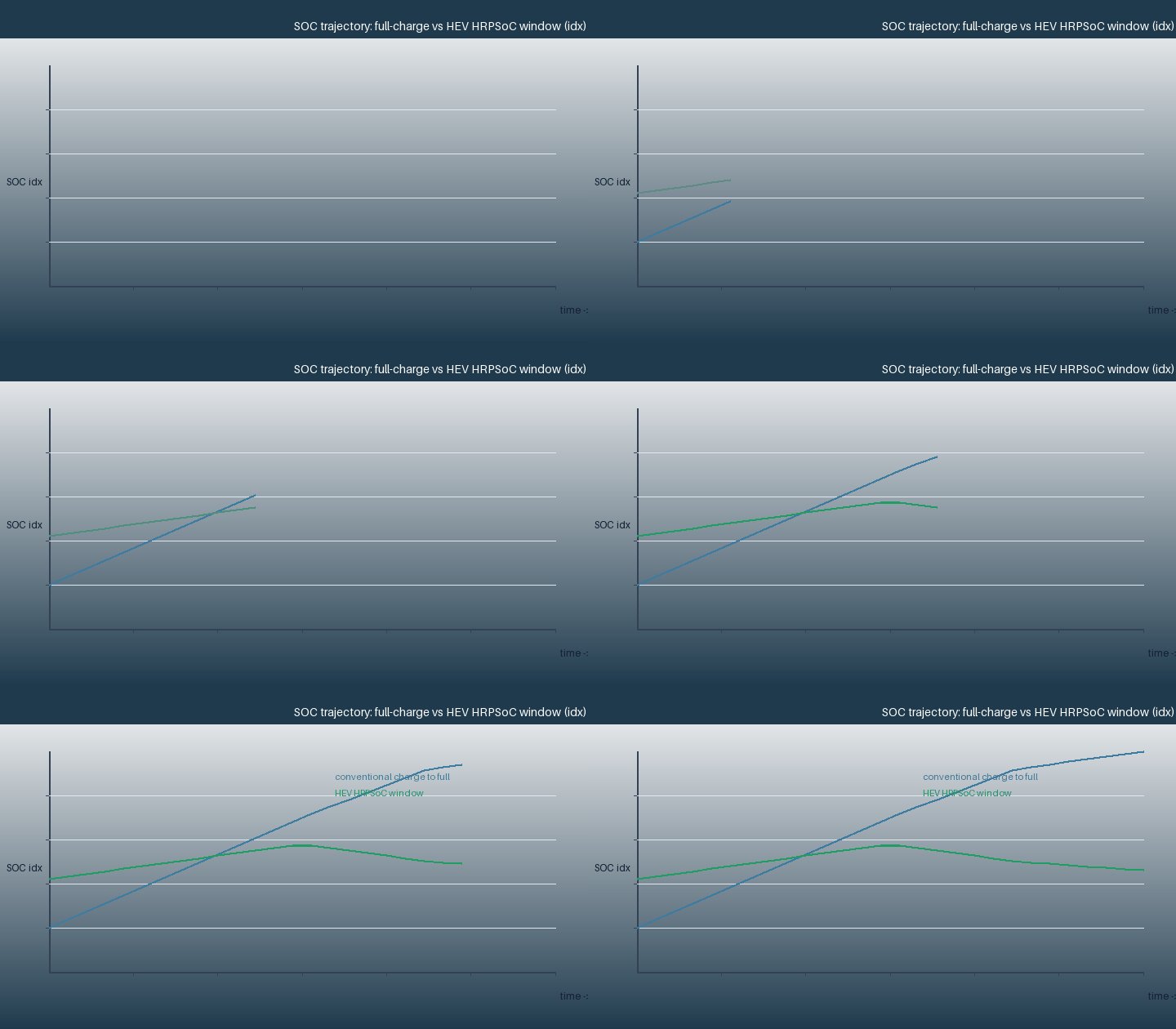
A hybrid battery must both accept regenerative charge and deliver assist discharge at any moment, which requires headroom in both directions; packs are therefore operated in a high-rate partial-state-of-charge window, commonly centred in the middle of the range rather than charged to full. Staying in this window avoids the oxygen-recombination end band almost entirely - the vehicle rarely sees a conventional 'full charge' - which is the single largest reason HEV NiMH packs achieve extraordinary cycle life despite brutal current pulses.
The control computer continually nudges SOC toward the window centre, charging a little when low and allowing discharge when high; this is charge control as continuous energy management rather than a discrete charge-to-full event, and it demonstrates that avoiding the high-SOC regime (Paper 2) is the most effective life strategy of all where the application permits.
During braking the motor becomes a generator and forces a high, briefly sustained charge current - multiples of the nominal C-rate - into the pack. Accepting such a pulse requires low charge-transfer and ohmic resistance (to limit voltage rise and heat), a negative with instant hydrogen-absorption capacity, and headroom below the oxygen knee so the pulse does not trigger gas. Because pulses are short and separated by discharge, average current stays moderate even though instantaneous current is high, and concentration gradients partially relax between events.
Pulse acceptance is therefore a distinct capability from sustained fast charge: a cell can accept a 5C, ten-second braking pulse it could never accept as continuous current, and cell and electrode design for HEV optimises precisely this transient surface and transport capability.
HEV-relevant internal resistance is measured with short DC pulses - reported practice uses 100-millisecond charge/discharge pulses within a 30 to 70 percent SOC window - capturing the ohmic and early polarisation response that determines voltage swing under regenerative and assist events. Mapping this resistance across SOC and temperature gives the controller a real-time limit on acceptable regenerative current: pulse current is capped so the resulting voltage stays below the oxygen-evolution and voltage limits at the present temperature.
This is resistance-based charge limiting in production: rather than a fixed regen current, the vehicle commands the largest pulse the measured cell state allows, derating automatically for cold, aged or high-resistance packs - the adaptive logic Papers 17 and 18 describe in embedded form.
HEV packs enforce the thermal discipline of Paper 28 at scale: forced air ducted through modules, temperature sensors across the pack, and current derating from the hottest module; series modules are matched and monitored to keep the divergence of Paper 29 within bounds across a decade of cycling. Because the pack never sits at 100 percent, recombination and overcharge wear are minimal, and the dominant ageing becomes slow resistance growth - monitored and accommodated by adaptive control rather than causing sudden failure.
The architecture is a worked demonstration that thermal management, conservative SOC operating window and adaptive pulse limiting together achieve longevity that any single measure alone could not.

Three principles transfer. First, operate below the oxygen knee wherever the duty cycle allows - partial-state operation is the kindest possible 'charge strategy'. Second, characterise and limit pulse current from measured resistance and temperature rather than a fixed value. Third, treat charge as a continuous control problem with thermal and SOC feedback, not an open-loop timer. The first figure contrasts a conventional full-charge trajectory with HEV HRPSoC window operation; the second sequences a regenerative pulse acceptance decision.
Power tools, mobile robots, mild-hybrid 48 V systems and regenerative industrial drives all face scaled versions of the same problem and benefit from the same logic.
Weijiang supplies high-rate NiMH grades with low pulse resistance, documented 100-millisecond pulse capability across SOC and temperature, and matched sets for pulse-duty packs, supporting designers applying HEV-style regenerative logic beyond automotive. The next application paper examines the opposite end of the spectrum - the familiar consumer AA/AAA charger and how independent-channel smart charging achieves a fast, gentle fill.
Weijiang Power designs and manufactures nickel-metal hydride cells, matched packs and charging-ready configurations for consumer, industrial, medical and mobility customers, and supports partners with charge-protocol guidance, IEC 61951-2 performance files, IEC 62133-1 safety evidence and charger co-validation. Share your cell format, charge rate, thermal envelope and cycle target and our engineers will specify a cell-and-charge combination that protects both runtime and service life. Review the range on the products page.


